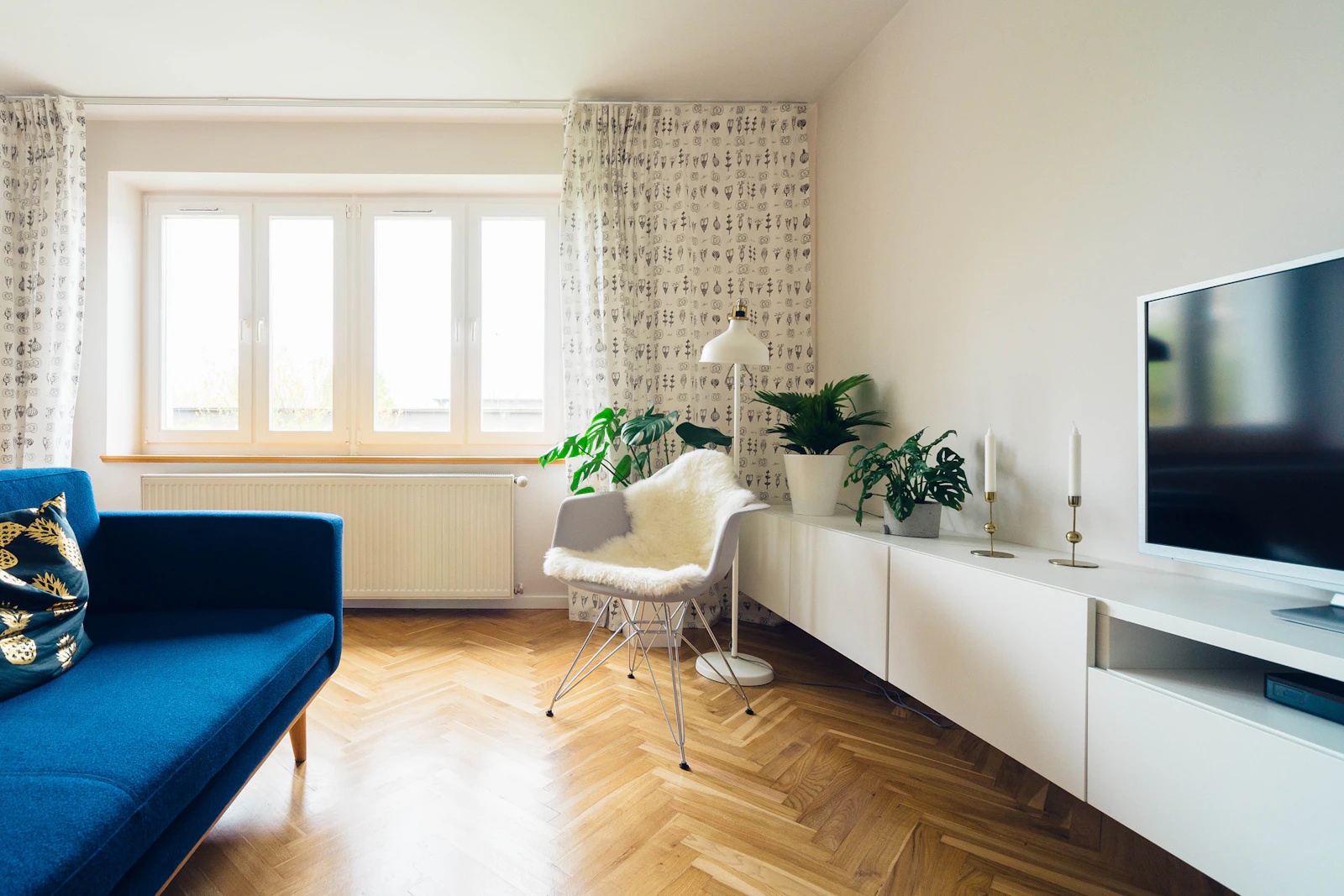
Furniture proportions
Choose pieces that match the room’s smallest dimension, not the furniture you liked in a larger store aisle. In a room eight feet wide, a deep sofa plus a full coffee table plus a walkway often cannot coexist. One of those elements has to shrink. A slimmer table, a shallower sofa, or a pair of small stools can be the difference between a path and an obstacle course.
Visible legs help. A bulky, skirted sofa in a compact room occupies visual volume as well as floor area. That does not mean every small room needs mid-century furniture; it means the silhouette should not be heavier than the room can carry.
Visual clutter
Clutter in a small space is not only mess. It is also many small decorative items, many open storage cubes, and many competing colors. Closed storage, even if modest, usually improves a compact room more than additional open shelves. If shelves stay open, treat them as a composition with empty intervals, not as overflow parking for objects.
Keep at least some horizontal surfaces clear. A small room in which every table is fully occupied has nowhere for daily life to land, so daily life lands on the chair.
Vertical space
Height can hold storage and art if the floor is already busy. A taller bookcase can replace a wider one. Curtains hung closer to the ceiling can lengthen the wall visually, provided the hardware and the rental rules allow it. This is a styling observation, not an instruction to drill into unknown wall types or to ignore lease terms.
Do not fill every vertical inch. A wall of objects from floor to ceiling can make a small room feel shorter, because the eye never rests.
Conceptual comparison only. Not a floor plan or a promise about a specific apartment.
Color choices
Small rooms do not require white. They do require relatedness. A compact space with four different wall and furniture colors can feel smaller because each color draws a boundary. A limited palette with variation in texture—linen, wood, ceramic—usually keeps more visual air.
High contrast on many small surfaces (dark frames, dark tables, dark lamps) can speckle the room. If you want contrast, concentrate it: one darker sofa, or one darker wall, not ten dark accents.
Multi-functional layouts
A room that must be living room and office cannot perform both jobs at full size. Decide which function occupies the better light and the larger piece. The second function should use furniture that can close, fold, or at least visually quiet down: a desk that faces a wall rather than a dining table permanently covered in monitors, for example.
Dual-purpose furniture helps only if you will actually convert it. A sofa bed that is never cleared is simply a sofa with poorer cushions.
Practical limitations
- Some rooms cannot hold a full dining table and a full sofa. Choose the daily function.
- Rental rules may prevent hanging, painting, or blocking heaters and exits.
- Storage that only works if you become a different person will not last.
- Mirrors can extend a view; they also double visual clutter if the opposite wall is busy.
For consultation focused on compact rooms, see small space styling.